How to Talk to an Adult Child About Their Drinking
The short answer
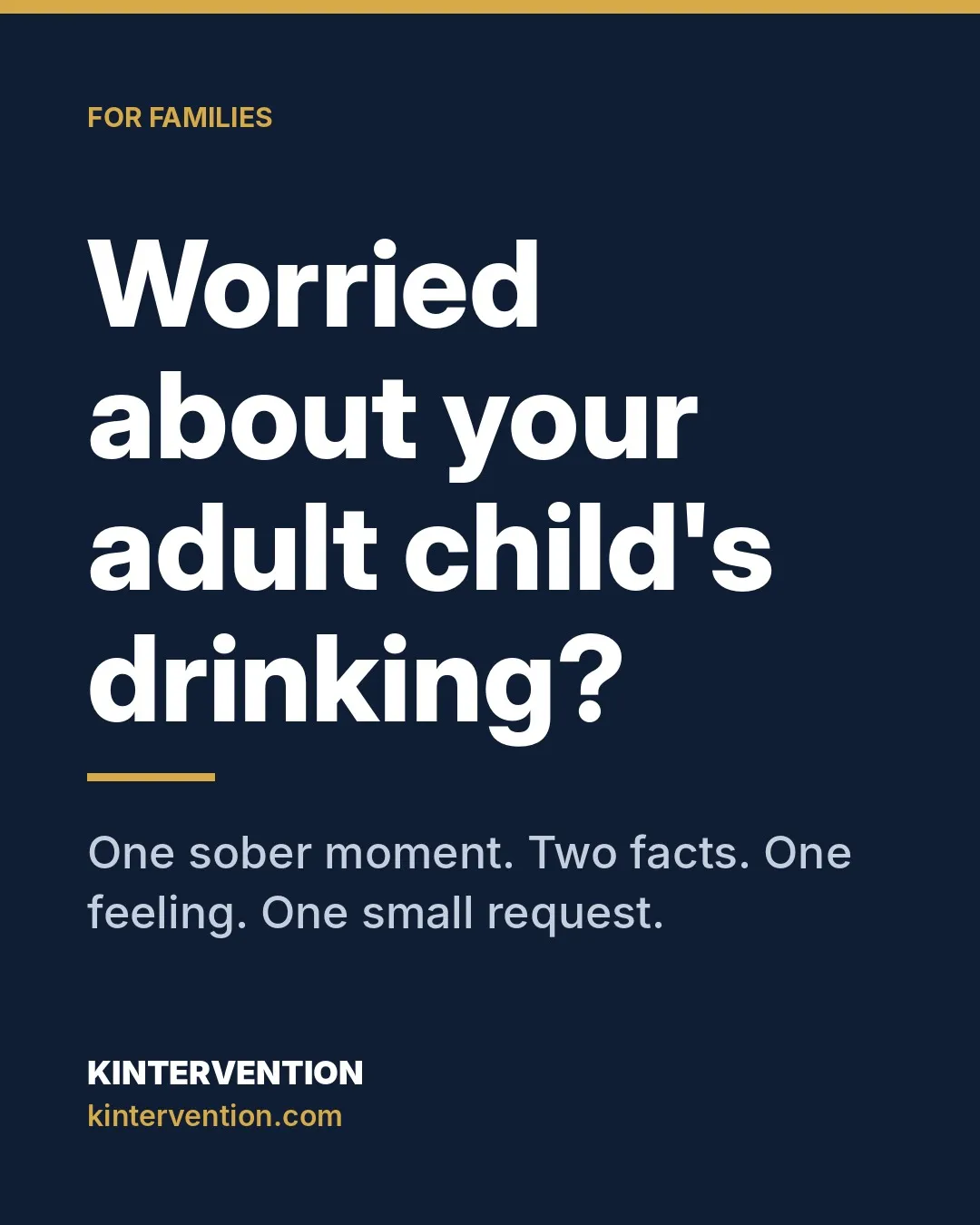
Parent of a grown son or daughter who drinks too much: the conversation works best when it is planned, short, and calm. Pick a sober moment. Name one or two specific things you saw. Say how you feel, not what is wrong with them. Make one small, clear request. Then stop talking and listen. You are not trying to win an argument about whether they are an alcoholic. You are trying to open a door they can walk back through later.
Why this is harder with an adult child
When your child was 15, you had rules, a curfew, and the car keys. At 28, you have none of that. They may have a job, a partner, their own kids. Many parents freeze because they are afraid of losing the relationship, or because the old parenting voice comes out and the conversation turns into a lecture. Both are normal. Neither works well. What works is talking to them as one adult who loves another adult and is worried.
Before you talk: 4 things to get ready
Choose the moment. Not while they are drinking, not the morning after a blowup, not at a family event. A quiet weekday, in person if possible, when neither of you is rushed.
Write down two specific moments. Facts you saw yourself. "At Sunday dinner you fell asleep at the table." "You called me at 1 a.m. and didn't remember it the next day." Specifics are harder to argue with than "you drink too much."
Decide your one request. Small and concrete: see a doctor and be honest about the drinking, talk to a counselor once, or meet with you and a professional. One request, not five.
Talk to your co-parent or partner first. If one parent says "we're worried" and the other says "they're just young," the conversation is over before it starts.
A simple script
Use your own words, but keep the shape:
Love first: "I love you, and I'm proud of a lot of who you are."
What you saw: "Last month at Sunday dinner you fell asleep at the table, and two weeks ago you called me late and didn't remember it."
How you feel: "I'm scared, and I don't want to pretend I'm not."
One request: "Would you be willing to talk to your doctor about your drinking? I'll help find one if you want."
Then listen: "What do you think?"
What to avoid
Labels like "alcoholic" or "drunk." They start a debate about the word.
Bringing up every mistake since high school.
Threats you will not keep. If you say it, mean it.
Expecting an answer on the spot. Defensiveness the first time is common. It does not mean nothing landed.
Quick win for today
Take a piece of paper and write three lines: one specific moment you saw, one sentence about how it made you feel, and one small request. Read it out loud once. If it sounds like a lecture, cut it in half. That paper is your conversation.
An example
An illustration, not a real family: a mother has hinted for a year that her 31-year-old son "should slow down." Every hint becomes a joke or an argument. This time she asks him to lunch on a Tuesday. She tells him about the night he drove her home from a wedding and she was frightened the whole way. She says she loves him and is scared. She asks one thing: that he see his doctor and be honest. He gets quiet, says he'll think about it, and changes the subject. Two weeks later he brings it up himself. That does not always happen. But a calm, specific conversation gives it a chance that a hint never did.
Fix Card: Parent conversation
Baseline (write it down before you start): When did you last talk to your adult child about their drinking without it turning into a fight? Write the date.
Done-right checklist (yes or no):
Picked a calm, sober time
Shared one specific worry with an example
Asked one open question and listened
Said what support you will and won't give
Evidence: A short note after the talk.
Recheck date: 7 days after you start.
Pass mark: A calm talk, even without agreement. If not, check: was it a calm time, and did you listen more than talk?
Your light: Red: avoided. Yellow: planned. Green: held calmly.
Report it: Log your result and set your light
Not sure where your family stands? Take the 2-minute Clarity Check.
If someone is in immediate danger or overdosing, call 911. For suicidal thoughts, call or text 988. SAMHSA helpline: 1-800-662-4357.
If you have already talked and nothing changed
Many parents reading this have had this conversation ten times. If so, another talk may not be the next step. A planned approach with the whole family, a ready treatment option, and clear changes in what you will keep covering may be. My own family did a professional intervention for me when I was around 40, after years of conversations that went nowhere. They loved me the whole time. What they never had was a plan. I am in long-term recovery today.
Not sure whether to talk again or try something different? Take the free KINTERVENTION Clarity Check. It takes a few minutes and helps you see where your family stands before you decide anything.
If this is an emergency: if someone is in immediate danger or may be overdosing, call 911 now. For thoughts of suicide, call or text 988. For free, confidential treatment referrals any time, call the SAMHSA National Helpline at 1-800-662-4357. This article is general information from a professional interventionist, not medical, clinical or legal advice.
You've tried everything. Now try a professional.
If you have talked to your son or daughter more times than you can count, let's look at what a plan for your family could look like. A first call is confidential and there is no pressure to decide anything on it. You can also call Michael directly at (708) 960-8353.
Book a confidential call with Michael
Send this to your spouse or your child's other parent, so you walk into this conversation on the same page.
