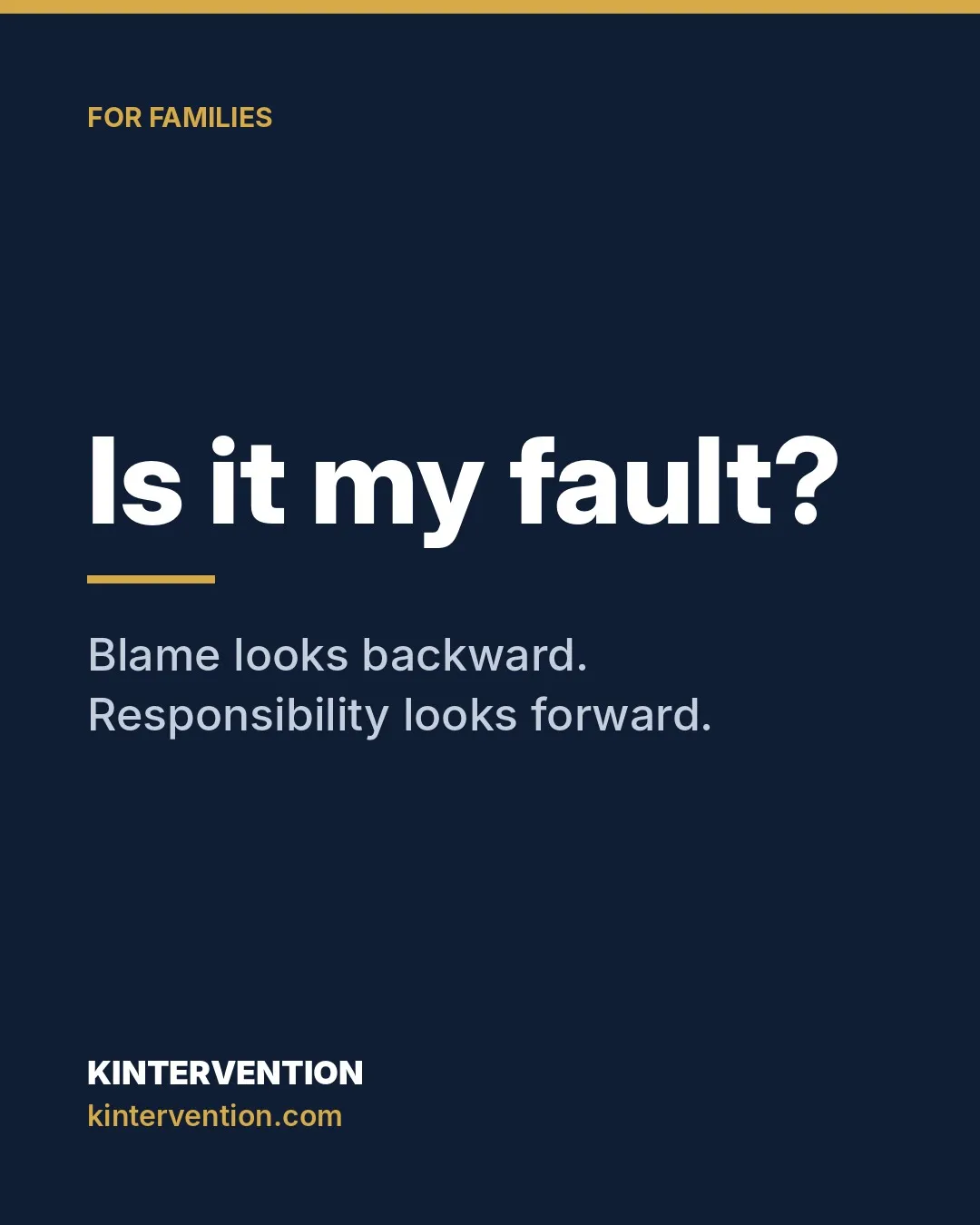
Is It My Fault My Child Is Struggling With Addiction?
The short answer
Parent lying awake asking what you did wrong: addiction is not caused by a single parenting choice, and blaming yourself will not help your child get better. Addiction is widely understood to have many contributing factors, including genetics, mental health, stress, trauma, and the people and substances around a person. You probably made mistakes. Every parent does. The useful question is not "Is it my fault?" but "What can I do now?"
Why parents blame themselves
Parenting teaches us that we are responsible for our children. So when a child is in trouble, the mind runs backward: the divorce, the move, working too much, being too strict or not strict enough. Guilt can feel like love, because it means you care. But guilt also drains the energy you need for what comes next, and it often leads straight to enabling: paying, covering, and rescuing to make up for the past.
Responsibility is not the same as blame
Blame looks backward and asks who caused this. It usually ends in shame or defensiveness.
Responsibility looks forward and asks what is mine to do now. It ends in action.
You can own real mistakes, and even apologize for them, without accepting that you caused your child's addiction. Those are two different things.
What is yours to do now
Stop paying for the problem. Look honestly at where your help makes drinking or using easier to continue.
Keep the relationship warm. Your child needs to know the door is open to them, even when it is closed to the addiction.
Get on one plan with the other adults. Parents who disagree are easy to divide.
Get support for yourself. Free groups like Al-Anon, Nar-Anon, and SMART Recovery Family & Friends exist because parents are carrying something heavy.
Be ready with help. Know what treatment would look like, so you are prepared the moment your child is open to it.
A word from the other side
I have been the child in this story. My family did a professional intervention for me when I was around 40. I know my parents asked themselves this question. Here is what I can tell you: the choices that fed my addiction were not my family's fault, and their love, once it had a plan behind it, is part of why I am in long-term recovery today. What they lacked was never love. It was a plan.
Quick win for today
Take two pieces of paper. On the first, write every "it's my fault because..." thought you have been carrying. On the second, write three things you can actually do this month. Fold up the first one and set it aside. Put the second one on the fridge. You can bring the first page to a counselor or support group. The second page is your job.
An example
An illustration, not a real family: a father believes his son's drug use started because of the divorce, so he keeps sending money and never says no. His ex-wife wants firmer limits, and the son plays them against each other. In a support group, the father hears another parent say, "My guilt was paying his rent." He goes home and calls his ex-wife. For the first time in years, they agree on one plan together. Nothing is fixed overnight. But their son now hears the same answer from both of them.
Fix Card: Guilt to action
Baseline (write it down before you start): On a scale of 1 to 10, how much guilt are you carrying about your child's addiction today?
Done-right checklist (yes or no):
Wrote what you can't control and what you can
Picked one action you can take this week
Found one support (group, counselor, friend)
Said one kind sentence to yourself
Evidence: Your 1–10 score today and in 7 days.
Recheck date: 7 days after you start.
Pass mark: Your score is lower, or you've taken one action. If not, check: did you reach out to one support, and are you focusing on what you can control?
Your light: Red: carrying it alone. Yellow: one support found. Green: one action taken and support in place.
Report it: Log your result and set your light
Not sure where your family stands? Take the 2-minute Clarity Check.
If someone is in immediate danger or overdosing, call 911. For suicidal thoughts, call or text 988. SAMHSA helpline: 1-800-662-4357.
If shame is taking over
If guilt has turned into hopelessness, or you are having thoughts of harming yourself, please call or text 988. You matter here too, not only as your child's parent.
Ready to move from "Is it my fault?" to "What do we do now?" Take the free KINTERVENTION Clarity Check. It takes a few minutes and helps you see where your family stands.
If this is an emergency: if someone is in immediate danger or may be overdosing, call 911 now. For thoughts of suicide, call or text 988. For free, confidential treatment referrals any time, call the SAMHSA National Helpline at 1-800-662-4357. This article is general information from a professional interventionist, not medical, clinical or legal advice.
You've tried everything. Now try a professional.
If guilt has been running your decisions, let's replace it with a plan your whole family can stand behind. A first call is confidential and there is no pressure to decide anything on it. You can also call Michael directly at (708) 960-8353.
Book a confidential call with Michael
Send this to the other parent, or to the friend who keeps telling you it isn't your fault, and believe them a little more today.
