Enabling vs Helping an Addict: How to Tell the Difference
The short answer
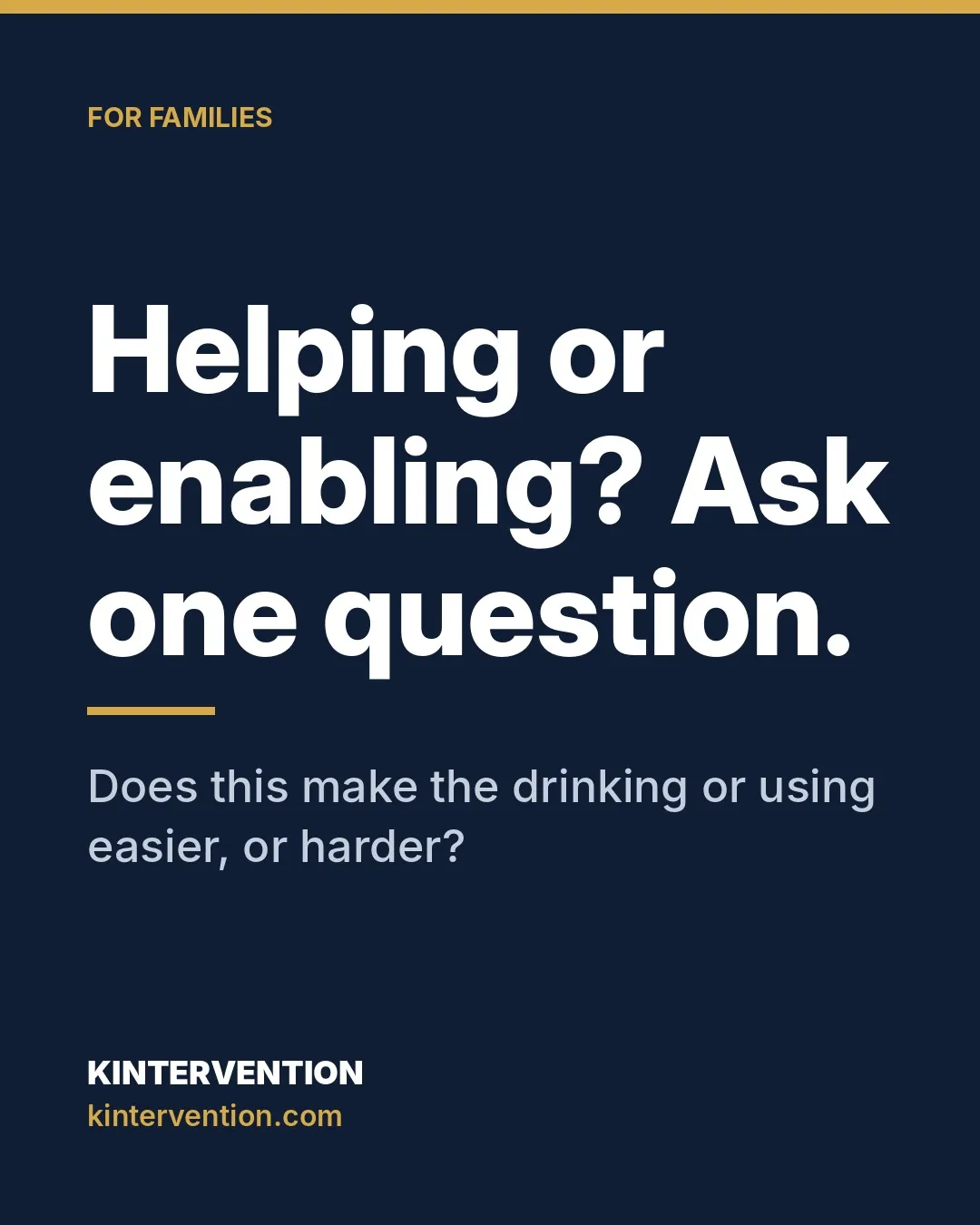
Parent, spouse, or sibling of someone who is drinking or using and won't get help: here is the clearest line I know. Helping makes recovery easier. Enabling makes the addiction easier. The same act, like paying a bill or making a phone call, can fall on either side depending on what it protects.
Most families who enable are not weak or naive. They are scared. They are trying to keep a job from being lost, a car from being repossessed, or a child from seeing something ugly. Enabling usually starts as love that ran out of a plan.
A one-question test
Before you say yes to the next request, ask yourself:
"If I do this, does the drinking or using get easier to continue, or harder?"
If your action removes a consequence that the addiction created, it is probably enabling. If your action supports a step toward treatment, honesty, or safety, it is probably helping.
3 mistakes that keep families stuck
1. Absorbing the consequences
Calling in sick for them. Covering a missed payment. Explaining away a missed holiday. Each one feels small. Together they send a clear message: the problem is being handled, just not by the person who has it.
2. Negotiating with the addiction
"You can live here if you only drink on weekends." "I'll give you money if you show me receipts." Deals like these put you in the role of police officer. The addiction is usually better at this game than you are, and you end up exhausted and resentful.
3. Everyone handling it differently
Mom gives money. Dad refuses. A sister lectures. A brother says nothing. When a family is not united, the person struggling simply goes to whoever says yes. This is the most common pattern I see, and it is the one that a plan fixes fastest.
What helping actually looks like
Paying for treatment directly, not handing over cash.
Letting natural consequences land, while making sure no one is in physical danger.
Saying a clear, calm no without a lecture attached.
Staying connected: a text that says "I love you and I'm here when you're ready for help" is helping.
Getting the family on one plan so every answer is the same answer.
Quick win for today
Take a sheet of paper and draw two columns. On the left, list everything you did in the last 30 days for the person you love: rides, money, phone calls, cover stories, cleanup. On the right, next to each item, write "easier to keep using" or "closer to help." You do not have to change anything yet. Just seeing the list clearly is the first step, and it is the list a professional will ask about anyway.
An example
Here is an illustration, not a real client. A father pays his adult daughter's rent every month because he is afraid she will end up on the street. Her drinking has continued for years. Using the test, the rent is removing a consequence. A helping version is not "cut her off tonight." It is this: the family agrees together that rent support continues for a set period only alongside an accepted treatment plan, and they present that as one united message, with love, in a planned conversation. Same father, same love, different direction.
Why this is so hard to do alone
Changing enabling patterns usually brings pushback: anger, guilt, promises, sometimes a crisis. Families often back down because they did not know that pushback was coming, or because one family member caves. That is not a character flaw. It is what happens when there was never a plan.
I know this from the other side. My family did a professional intervention for me around age 40. Before that, they had tried everything they could think of. What they did not have was a plan, a script, and someone to guide them through it. I am in long-term recovery today, and that is the work I now do for other families.
What to do next
Do the two-column exercise above.
Pick one enabling behavior you are willing to stop, and talk with the rest of the family before you change it.
If the family can't agree, or you're afraid of how the person will react, talk to a professional before you act.
If this is an emergency: if someone is in immediate danger or may be overdosing, call 911 now. For thoughts of suicide, call or text 988. For free, confidential treatment referrals any time, call the SAMHSA National Helpline at 1-800-662-4357. This article is general information from a professional interventionist, not medical, clinical or legal advice.
Fix Card: Enabling audit
Baseline (write it down before you start): List everything you did for your loved one this week. How many items protected them from a consequence of their use?
Done-right checklist (yes or no):
Every "help" from this week written down
Each one marked: helps recovery, or softens a consequence
One enabling habit picked to stop
What you'll say instead written in one sentence
Evidence: Your marked list.
Recheck date: 7 days after you start.
Pass mark: One enabling habit stopped for 7 days, calmly. If not, check: did you tell them in advance, and did everyone in the family agree?
Your light: Red: not looked at. Yellow: list made. Green: one habit stopped and held for a week.
Report it: Log your result and set your light
Not sure where your family stands? Take the 2-minute Clarity Check.
If someone is in immediate danger or overdosing, call 911. For suicidal thoughts, call or text 988. SAMHSA helpline: 1-800-662-4357.
You've tried everything. Now try a professional.
If you are not sure where helping ends and enabling starts in your family, let's sort it out together. A first call is confidential and there is no pressure to decide anything on it. You can also call Michael directly at (708) 960-8353.
Book a confidential call with Michael
Know someone carrying this alone? Send this to your spouse, your sister, or whoever else is in this with you, so you can all start from the same page.
